
The European Committee of the Regions (CoR) and the European Olympic Committees (EOC) have urged EU co-legislators to embed sport across all Multiannual Financial Framework (MFF) 2028–2034 funding instruments and to ensure that sports organisations have direct, simplified access to EU funds.
Sport is a strategic investment for a stronger and more resilient Europe. Every €1 invested in sport generates around €5 in socio-economic benefits, and the sector contributes 2.12% of EU GDP. At the same time, physical inactivity places an estimated €80 billion annual burden on European healthcare systems, underlining the cost of underinvesting in physical activity.
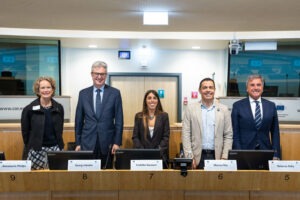
4 June 2026, The enabling role of sport to achieve EU objectives and future support via the Multi-annual Financial framework 2028-2034
Belgium - Brussels - June 2026
© European Union / Giedrė Daugėlaitė
During the event 'The enabling role of sport to achieve EU objectives and future support via the MFF 2028–2034', the CoR and the EOC called for sport to be mainstreamed across multiple EU policy areas under a 'sport in all policies' approach. Whilst support through the future Erasmus+ programme remains the most evident and accessible route for sport organisations to contribute to EU policy priorities, the extent to which the enabling role of sport will be recognised within the broader MFF — particularly in the National and Regional Partnership Plans, the European Regional Development Fund (ERDF) and the European Social Fund (ESF+) — remains under discussion. Participants called for clarity and ambition on this front.
They further requested that direct and simplified access to funding be guaranteed at national, regional and local level, and that the contribution of sport organisations to health, social inclusion, youth engagement and regional development be explicitly acknowledged within the MFF 2028–2034 architecture.
Among the speakers, CoR members Sari Rautio (FI/EPP) and Roberto Pella (IT/EPP) underlined the importance of sport as a vehicle for cooperation, growth and social cohesion. MEP Bogdan Zdrojewski (PL/EPP) highlighted Erasmus+ as a key driver of inclusion and stressed the need to protect and increase its share within the next MFF. MEP Sabrina Repp (DE/PES) pointed to sport as a foundation for achieving the objectives of cohesion policy, building community, and fostering participation and trust.
Roberto Pella (IT/EPP), CoR Rapporteur on Sport and on Erasmus+: “Erasmus+ is not just a programme for mobility, education and sport; it is a cornerstone of our shared identity, which we must always strive to strengthen. Stronger partnerships, along with technical capacity-building programmes in the most vulnerable areas, are needed to enable all communities — including those in the most peripheral and inner areas — to benefit fully from the role of sport in promoting inclusion and social cohesion. In this regard, the sporting dimension of all European programmes should be strengthened, in line with a 'sport in all policies' approach, recognising the educational and social value that sport brings every day at regional, provincial and municipal levels.”
EOC Executive Committee (ExCom) member Annamarie Phelps highlighted the unique power of sport as a vehicle to help achieve the EU’s most pressing priorities and model the behaviours the EU wants to encourage, while fellow EOC ExCom member José Manuel Araújo underlined the EOC’s commitment to working with the CoR, the European Parliament and the European Commission to ensure sport is recognised as a strategic investment in Europe’s future.
Annamarie Phelps OLY, EOC Executive Committee Member: “Sport is a powerful and cost-effective tool for delivering European priorities. National Olympic Committees, Federations, clubs and volunteers contribute to inclusion, health, education, sustainability and community resilience, while European sport events create lasting social and economic legacies for cities and regions. The next Multiannual Financial Framework must recognise this contribution by explicitly integrating sport across relevant funding instruments and enabling sport organisations to play their full role as a driver of social impact, regional development and community resilience across Europe.”
The conference featured project examples illustrating the tangible impact of EU-funded sport initiatives at local and regional level. Representatives from Denmark and Slovenia demonstrated how National Olympic Committees have drawn on Erasmus+ Sport, the ERDF and the ESF+ to support regional development and attractiveness, as well as public health, whilst opening up opportunities for young people and pathways to employment. Tiago Carvalho, Member-at-large of the European Paralympic Committee, highlighted how para-sport initiatives across Europe have delivered inclusion outcomes that extend well beyond the sport sector itself.
Prof. Dr. Maja Zalaznik, Chair of the International Commission, National Olympic Committee of Slovenia & EOC EU Commission Member: “Sport organisations deliver where governments alone cannot. The projects presented today demonstrated how sport organisations can reach and engage people and communities that public institutions sometimes struggle to connect with. When sport organisations and local authorities work hand-in-hand, they can create tangible benefits for citizens, cities and regions, both on and off the field of play. Because sport brings multiple societal benefits, it should be supported across multiple funding instruments in the MFF.”
The discussion sought to shape how sport is recognised and supported within the European Union for the decade to come, highlighting the need for the contribution of NOCs, Federations and grassroots sport organisations to cities and regions to be better reflected in EU funding frameworks and for organised sport stakeholders to be recognised as key partners in delivering lasting benefits for local communities across Europe.
Carlotta Giussani – Director, EOC EU Office
"The evidence is clear: across Europe, sport organisations are already delivering measurable social impact with limited resources - strengthening inclusion, health, education, active citizenship and community cohesion. The next MFF should therefore explicitly recognise sport across EU funding instruments and empower local and regional authorities to invest in sport. By recognising clubs, Federations and National Olympic Committees as key players in concretely translating EU objectives into practice, Europe can unlock greater social impact, stronger regional development and lasting benefits for its communities."