
European sport organisations already have access to practical tools, knowledge and experience to strengthen their governance; however, the key is turning these resources into action through ad-hoc tailored activities, capacity-building and peer-to-peer exchanges.
While good governance is a longstanding commitment of the European Olympic Movement and a key priority for the EOC EU Office, as expectations from athletes, public authorities, partners and society continue to evolve, National Olympic Committees, Federations and other sport organisations are increasingly under scrutiny to demonstrate transparency, accountability, integrity and effective decision-making. For organisations with limited resources, strengthening governance structures can nevertheless appear challenging; indeed, strong governance does not come from principles alone, it requires continuous capacity-building, practical support and opportunities to learn from the experience of others.
Building on European experience
Over the years, European cooperation, including through Erasmus+ Sport, has supported the development of a wide range of resources aimed at strengthening governance across sport. Rather than focusing only on principles and recommendations, many initiatives have developed practical self-assessment tools, implementation guidance, templates and educational resources that sport organisations can adapt to their own circumstances.
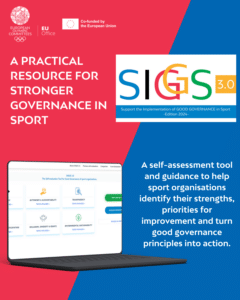
SIGGS 3.0 is one such example. Building on the EOC EU Office's longstanding commitment on good governance, this project provides sport organisations with a practical framework to assess their governance, identify strengths and areas for improvement, and translate governance principles into concrete actions. Together with initiatives such as POINTS, RINGS and other governance-focused European collaborations, these resources demonstrate that good governance is a continuous process of learning, assessment and improvement rather than a one-off exercise.
Governance is more than compliance
Good governance is sometimes viewed primarily through the lens of regulations, requirements and reporting. In practice, however, effective governance can help organisations make better decisions, strengthen accountability and stakeholder trust, clarify responsibilities, manage risks and build greater organisational resilience. Good governance should therefore not simply be approached as a compliance requirement, but as an investment in stronger and more sustainable sport organisations.
Turning principles into practice
Improving governance does not necessarily require major structural reforms as progress can begin with relatively straightforward questions:
- Are roles and responsibilities clearly defined?
- Are decision-making processes transparent?
- How are conflicts of interest managed?
- Are athletes and other relevant stakeholders appropriately represented?
- Does the organisation regularly assess its governance and identify areas for improvement?
Existing European resources such as SIGGS 3.0, POINTS, RINGS (among others) provide practical frameworks to help organisations answer these questions and identify realistic and achievable steps forward.
Capacity-building through European cooperation
This is where capacity-building and European cooperation can make a tangible difference. By bringing sport organisations together to exchange experiences, learn from peers and make use of tools and approaches already tested across Europe, cooperation can help turn common governance principles into practices that work within different organisational and national contexts.
This approach lies at the heart of the EOC EU Office's work on good governance: combining practical tools with capacity-building, knowledge-sharing and peer exchange to support organisations in continuously strengthening their governance. Because good governance does not have a final destination. It is a process of continuous improvement – and ensuring that sport organisations have the knowledge, tools and capacities to move forward is an essential part of that process and a core duty of the Olympic Movement.