
MANY SPORT ORGANISATIONS WANT TO IMPROVE GENDER EQUALITY — BUT WHERE SHOULD THEY START?
Across Europe, gender equality is increasingly recognised as fundamental to good governance, stronger leadership and more inclusive decision-making. Yet, advancing gender equality goes well beyond increasing female participation. It also means ensuring equal opportunities in leadership, governance, coaching, officiating and recruitment, while fostering inclusive organisational cultures and sporting environments that respond to the specific needs of women and girls.
Translating these ambitions into practical action can remain challenging, particularly when organisations face limited resources, competing priorities or uncertainty about which measures to implement. Fortunately, numerous Erasmus+ Sport projects have already developed practical tools, methodologies and good practices to support organisations in addressing these challenges, taking into account their different needs, capacities and circumstances.
The priority is therefore not always to develop new solutions, but to strengthen the capacity of sport organisations to identify, access, adapt and effectively implement existing resources, building on European cooperation rather than unnecessarily duplicating efforts.
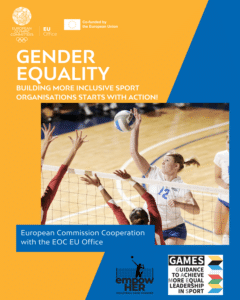
LEARNING FROM EUROPEAN PRACTICE: GAMES, EMPOWHER AND GAME CHANGER
Several EU-funded initiatives offer practical examples of how sport organisations can translate gender equality commitments into meaningful action.
The Erasmus+ Sport co-funded GAMES project – Guidance to Achieve
More Equal Leadership in Sport, coordinated by the EOC EU Office, developed tools to support gender equality in leadership and decision-making within European National Olympic Committees. Its Pool of Actions, comprising 30+ measures, addresses three complementary pillars:
Structural measures: Strengthening organisational frameworks and procedures to promote more balanced representation in leadership and decision-making.
Pathways for women: Creating opportunities for women to access and progress towards leadership positions through mentoring, networking and capacity-building.
Organisational culture: Addressing stereotypes and barriers while promoting more inclusive organisational environments.
Building on this experience, EMPOWHER – Volleyball Game Changer, led by the European Volleyball Confederation (CEV), adapts and further develops these approaches within volleyball governance. Through organisational assessments, a dedicated Pool of Actions and tailored action plans, the project supports volleyball organisations in strengthening gender equality in leadership and decision-making.
At the same time, GAME CHANGER – Advancing Female Health in European Organised Sport, developed by the EOC EU Office in cooperation aims to address another important dimension of gender equality: integrating female health considerations into sport governance, organisational policies and daily practices.
These initiatives are just a few examples of the many projects supported through EU funding. Together, they demonstrate how European cooperation can address complementary challenges, build on existing methodologies and develop practical resources and educational activities tailorable to different sporting contexts.
SMALL CHANGES CAN CREATE LASTING IMPACT
Advancing gender equality does not necessarily require major organisational reforms from the outset. Practical measures can include:
- Reviewing recruitment and nomination procedures.
- Introducing mentoring and leadership development programmes.
- Improving gender balance within governing bodies and committees.
- Collecting and monitoring gender-disaggregated organisational data.
- Establishing clear equality objectives and action plans.
- Integrating female health considerations into organisational policies and practices.
While these actions may appear modest, they can provide an important foundation for broader and more sustainable organisational change. The key is to identify measures that respond to the organisation's specific needs, adapt them to its operational context and regularly assess progress.
LOOKING AHEAD: FROM DEVELOPING RESOURCES TO BUILDING CAPACITY
GAMES, EMPOWHER and GAME CHANGER represent only a small part of the wealth of knowledge, tools and good practices developed — or currently being developed — through EU-funded cooperation.
While innovation remains essential to address emerging challenges and existing gaps, greater attention should also be placed on avoiding unnecessary duplication and strengthening the capacity of sport organisations to make effective use of resources already available.
This means supporting organisations in identifying relevant tools, adapting proven methodologies to their own circumstances and translating existing knowledge into concrete improvements in governance and organisational practices.
Through its capacity-building and networking activities, the EOC EU Office remains committed to promoting the exchange and uptake of EU-funded project results, fostering complementarities between initiatives and strengthening their long-term impact.
Over the coming months, the EOC EU Office will continue showcasing practical resources, experiences and good practices that sport organisations can adapt, regardless of their size or previous experience. Yet the objective is not to prescribe identical solutions or continuously reinvent existing ones, but to build on what has already been achieved and equip sport organisations with the knowledge and capacity to turn gender equality commitments into lasting change.