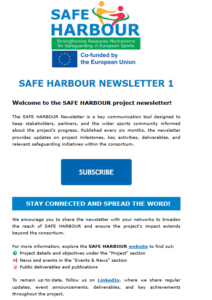
The SAFE HARBOUR project has officially launched its first newsletter, marking an important milestone in its mission to raise awareness of safeguarding in European sport.
Published every six months, the newsletter aims to keep stakeholders, partners, and the wider sporting community informed about the project’s progress, key developments, and upcoming initiatives. It provides regular updates on major milestones, deliverables, and best practices in safeguarding.
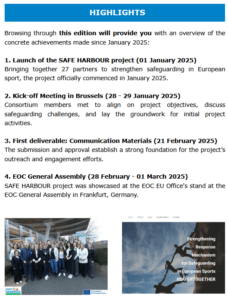
The inaugural edition of the SAFE HARBOUR newsletter offers a comprehensive overview of the project’s initial achievements since its official launch in January 2025. The key highlights include its first in-person Project Meeting, followed by the submission and approval of its first project deliverable: the Communication Materials. These materials showcase the newly launched SAFE HARBOUR website, social media platforms, logo, leaflet. Besides, it provides insights on the EOC General Assembly, which served as a key platform to disseminate the SAFE HARBOUR project among relevant stakeholders within and beyond the Olympic Movement.
In addition to SAFE HARBOUR’s progress, the newsletter highlights other key safeguarding initiatives among partners, including Erasmus+ projects such as GUARD, coordinated by the National Olympic Committee of Croatia, and GRASS, coordinated by the National Olympic Committee of Portugal.
Looking ahead, the SAFE HARBOUR consortium remains committed to expanding its efforts and building on the progress achieved in its initial months!
Subscribe to the SAFE HARBOUR Newsletter to stay informed and remain engaged by following the project on LinkedIn and visiting the website for the latest news. The next SAFE HARBOUR Newsletter is scheduled for October 2025 – stay tuned!
Background information on the SAFE HARBOUR project.
The SAFE HARBOUR project, short for “Strengthening Response Mechanisms for Safeguarding in European Sport”, is a 30-month project co-funded by the European Union through the Erasmus+ Sport Programme 2024. Coordinated by the EOC EU Office, the consortium includes Thomas More and Asser Institute as experts on safeguarding, human rights and law, 2 International Federations (International Biathlon Union and International Ice Hockey Federations), and 20 National Olympic Committees (Belgium, Bosnia and Herzegovina, Croatia, Cyprus, Czechia, Denmark, Germany, Hungary, Kosovo, Latvia, Lithuania, Luxembourg, Malta, Montenegro, Norway, Poland, Portugal, Romania, Slovakia and Slovenia). Additionally, the International Olympic Committee (IOC) is involved as an outside resource.
The project seeks to strengthen the capacity of European NOCs and Federations to address safeguarding concerns by identifying gaps, developing a European Response framework, and fostering collaboration. This framework will be adapted to national contexts, complemented by training and awareness initiatives to enhance safeguarding measures at both national and European levels. Therefore, SAFE HARBOUR aims to equip partner NOCs and Federations with the tools and confidence to implement effective safeguarding measures while establishing a robust support network for Safeguarding Officers and laying the groundwork for a future IOC Regional Safeguarding Hub.