
On the 8th of May 2026, the EOC EU Office participated in the “Protecting our Athletes” Athlete Welfare in Sport Conference, hosted by European Aquatics in Dublin, Ireland, where the SAFE HARBOUR project was presented. The event gathered more than 130 delegates from across Europe, from sport leaders to safeguarding specialists, former athletes, policymakers as well as representatives of international sport organisations.
A strong message came out of the conference: safeguarding can no longer be treated as a secondary concern across European sport. Participants broadly agreed that it must be woven into the fabric of organisational governance at every level, reflecting a fundamental responsibility of those who run and regulate sport today. A recurring theme throughout the day was the need to shift away from reactive, case-by-case responses and toward coordinated, athlete-centred systems built on trauma-informed approaches and led by qualified professionals.
Speakers also drew attention to the practical hurdles that safeguarding officers and organisations continue to face, ranging from insufficient dedicated expertise to a lack of sustainable structures as well as limited leadership buy-in and response mechanisms that are not always equipped to handle concerns promptly or adequately. Against this backdrop, the conference pointed to education, accountability, independent oversight and closer collaboration between sport bodies, public institutions and policymakers as priority areas for progress.

At the occasion, Carlotta Guissani, Director of the EOC EU Office, presented the SAFE HARBOUR project as a concrete contribution to the ongoing efforts to strengthen safeguarding systems across European sport. The intervention outlined the project’s work to build safeguarding capacity within European National Olympic Committees and Federations, covering gap analysis, the development of a European Response Framework, national safeguarding strategies, training activities and improved coordination across the sport sector.
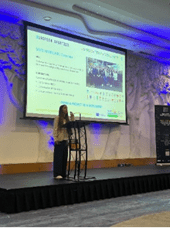
The project’s recent achievements were also highlighted, among which, the completion of the GAP Report, the creation of a safeguarding stakeholders database and the development of a ranking/classification system for safeguarding concerns and violations. More largely, SAFE HARBOUR was increasingly recognised as part of a wider movement working to embed stronger safeguarding governance, coordination and response mechanisms into the fabric of European sport. The conference equally served as a valuable opportunity for the EOC EU Office to deepen its engagement with stakeholders from throughout the European Olympic Movement and the broader sport ecosystem, reinforcing the shared ambition to drive meaningful and lasting change in how safeguarding is approached across the continent.
Background information on the SAFE HARBOUR project.
SAFE HARBOUR, standing for “Strengthening Response Mechanisms for Safeguarding in European Sport”, is a 30-month project co-funded by the European Union through the Erasmus+ Sport Programme 2024. Coordinated by the EOC EU Office, the consortium brings together Thomas More and the Asser Institute as experts in safeguarding, human rights and law, alongside 2 International Federations (the International Biathlon Union and the International Ice Hockey Federation) and 20 National Olympic Committees (Belgium, Bosnia and Herzegovina, Croatia, Cyprus, Czechia, Denmark, Germany, Hungary, Kosovo, Latvia, Lithuania, Luxembourg, Malta, Montenegro, Norway, Poland, Portugal, Romania, Slovakia and Slovenia). The International Olympic Committee (IOC) is also involved as an external resource.
The project aims to strengthen the capacity of European NOCs and Federations to address safeguarding concerns by identifying gaps, developing a European Response framework and fostering collaboration. This framework will be adapted to national contexts and complemented by training and awareness initiatives to enhance safeguarding at both national and European levels. Ultimately, SAFE HARBOUR seeks to equip partner organisations with the tools and confidence to implement effective safeguarding measures, establish a robust support network for Safeguarding Officers, and lay the groundwork for a future IOC Regional Safeguarding Hub.