June 2025 marks the completion of the first six months of the SAFE HARBOUR project. Six months during which the consortium has already achieved significant progress across several key areas. From the official launch of the project and its media channels, regular consortium and expert exchanges to the delivery of the first approved deliverable, the consortium demonstrates a shared commitment to constructive exchanges, open communication and positive cooperation to jointly strengthening safeguarding mechanisms in European sport.
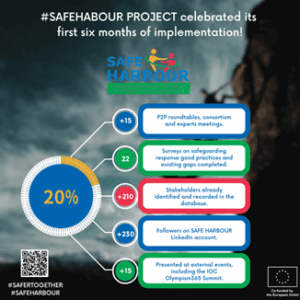
The project officially started in January 2025 with the first in-person meeting held in Brussels (Belgium) on the 28th and 29th of January 2025. This meeting provided a valuable opportunity for partners to meet face to face, align on project objectives, and begin collective reflection on safeguarding challenges in sport. Since then, experts exchanges and Monthly Consortium Meetings have been held regularly, allowing partners to stay aligned, clarify roles and responsibilities, track progress, and ensure continuous contribution and shared coordination throughout the implementation of the project.
Structured in three phases, the SAFE HARBOUR project begins by identifying gaps, key stakeholders, and patterns of safeguarding violations. It then moves towards the co-development of a European Response Framework – a shared advisory tool aligned with the IOC’s global safeguarding standards but adapted to Europe’s legal and institutional context. In the final phase, each NOC will translate the framework into a tailored national strategy and deliver training to their leadership and National Federations.
The project is currently in its first phase, focusing on building a shared understanding of existing safeguarding realities and practices across Europe. Accordingly, the consortium is advancing three key activities in parallel: a GAP questionnaire was launched to identify both good practices and existing gaps in the procedures and systems of European NOCs and Federations for responding to safeguarding concerns and violations. The responses are currently being analysed and will inform a comprehensive GAP report. This analysis also supports the ongoing mapping of key stakeholders involved in safeguarding across sport and non-sport sectors, helping to clarify roles, responsibilities, and collaboration mechanisms within partner countries. Besides, the consortium is conducting regular Peer-to-Peer (P2P) Roundtables, which serve as a preparatory step towards jointly developing a classification tool for safeguarding concerns and violations in sport. These sessions have so far addressed organisational readiness and commitment, implementation barriers between policy and practice, and the importance of multi-stakeholder and cross-sectoral cooperation.
The SAFE HARBOUR project has also successfully launched its official website, social media platforms, and biannual newsletter, marking a significant step forward in its outreach and visibility efforts. These communication tools are designed to facilitate transparent and ongoing engagement with stakeholders, policymakers, and the wider sporting community. While the website serves as a central hub for project updates, resources, and publications, the LinkedIn page enables real-time interaction, and the newsletter provides curated insights into project progress, key milestones, and safeguarding initiatives from across Europe.
In addition, SAFE HARBOUR has already achieved notable visibility within the Olympic Movement. The project was featured at the 54th EOC General Assembly in February 2025, and at the Olympism365 Summit in June 2025. These high-level engagements underscored the project's pivotal role in supporting NOCs and Federations in advancing safeguarding policies, while also reinforcing the SAFE HARBOUR’s position as a key contributor to safeguarding discourse within Europe and beyond.
All in all, the first six months of the SAFE HARBOUR project have demonstrated the strength of a committed consortium and laid a solid foundation for the work ahead. The next in-person project meeting is scheduled to take place in October 2025 in Bucharest, Romania, and will be complemented by regular online exchanges. Moving forward, through continued collaboration, and the sharing of expertise, the consortium aims to strengthen safeguarding response mechanisms across Europe, while also laying the groundwork for the establishment of the IOC Regional Safeguarding Hub.
Background information on the SAFE HARBOUR project
The SAFE HARBOUR project, short for “Strengthening Response Mechanisms for Safeguarding in European Sport”, is a 30-month project co-funded by the European Union through the Erasmus+ Sport Programme 2024. Coordinated by the EOC EU Office, the consortium includes Thomas More and Asser Institute as experts on safeguarding, human rights and law, 2 International Federations (International Biathlon Union and International Ice Hockey Federations), and 20 National Olympic Committees (Belgium, Bosnia and Herzegovina, Croatia, Cyprus, Czechia, Denmark, Germany, Hungary, Kosovo, Latvia, Lithuania, Luxembourg, Malta, Montenegro, Norway, Poland, Portugal, Romania, Slovakia and Slovenia). Additionally, the International Olympic Committee (IOC) is involved as an outside resource.
The project seeks to strengthen the capacity of European NOCs and Federations to address safeguarding concerns by identifying gaps, developing a European Response framework, and fostering collaboration. This framework will be adapted to national contexts, complemented by training and awareness initiatives to enhance safeguarding measures at both national and European levels. Therefore, SAFE HARBOUR aims to equip partner NOCs and Federations with the tools and confidence to implement effective safeguarding measures while establishing a robust support network for Safeguarding Officers and laying the groundwork for a future IOC Regional Safeguarding Hub.