EU FUNDING

EU and funding

Multiannual Financial Framework 2028-2034

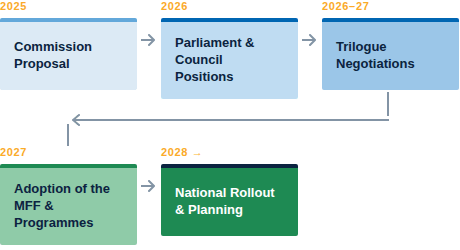
Every seven years, the EU sets its long-term budget – the Multiannual Financial Framework (MFF) – determining its spending priorities for the years ahead. In July 2025, the European Commission presented its proposal for the 2028–2034 MFF, worth almost €2 trillion. Negotiations are now underway between the European Parliament and the Council, with the future EU budget expected to respond to growing priorities including competitiveness, security and defence, resilience, the green and digital transitions.

EOC EU Office message for the MFF 2028-2034: 
Sport is an investment, not a cost

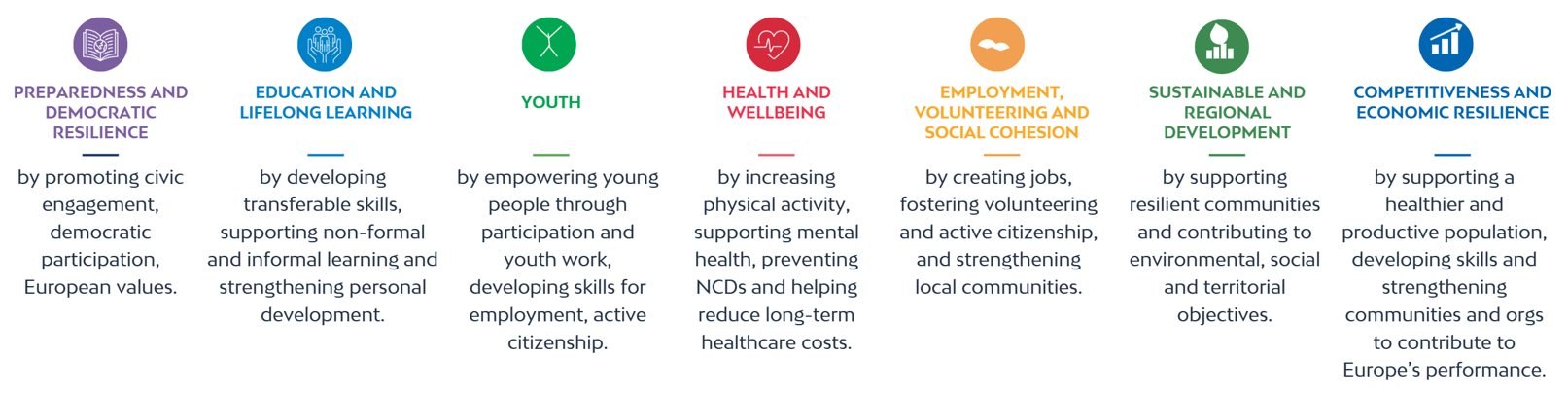
Sport is often perceived as a cost to public budgets. Yet investment in sport generates significant returns for individuals, communities and society. Across Europe, National Olympic Committees, federations, clubs and grassroots sports organisations promote healthier lifestyles, strengthen social inclusion, support education and skills development, foster volunteering and active citizenship, generate economic activity and reinforce community resilience.

Sport’s contribution to EU and national policy priorities is evident, yet poorly recognised. In particular, sport supports:
EOC EU Office demands for the MFF 2028-2034

The Multiannual Financial Framework (MFF) should combine dedicated funding for sport with mainstreaming across EU policy and funding programmes. Sport should be clearly visible and eligible in key instruments, in particular Erasmus+, National and Regional Partnership Plans (NRPPs) and related sectoral regulations, AgoraEU and the Competitiveness Fund. This would enable the EU, Member States and local authorities to better harness sport’s potential and allow sports organisations to translate European/national priorities in practical action.

By explicitly integrating sport across EU funding programmes and recognising sport organisations as key partners in translating European priorities into concrete action, the next MFF can maximise social impact, strengthen regional development and deliver lasting benefits for citizens and communities across Europe.

Erasmus+
Other funding programmes
An ambitious and sustainable Erasmus+ budget
A minimum 5% share for sport in the future Erasmus+ programme
Financial stability through annual earmarking
Support for Large-Scale European Sport Events
Expanded learning mobility in sport
Strengthened support for volunteering
Simplified access to Erasmus+ results
ERDF: Recognise sport as a driver of regional development
ESF: Recognise sport as a driver of social inclusion and skills development
CAP/EAFRD/LEADER: Recognise sport as driver of resilient rural communities
AgoraEU: Recognise sport as a pillar of European civil society
Competitiveness Fund: Recognise sport as as strategic investment in health prevention and competitiveness

Spread the message: Sport is an investment, not a cost

Click below to see the EOC EU Office's position paper for the Multiannual Financial Framework 2028-2034. Use the executive summary, long version or programme-specific version to spread the message and support our advocacy campaign.

Multiannual Financial Framework 2021-2027

The EU’s budget for the Multiannual Financial Framework (MFF) 2021-2027 is set at €1.211 trillion, averaging at around €173 billion per year. Accordingly, the European Commission’s Political Guidelines for the legislative session 2019-2024 focus on six thematic headlines:
  • A European Green Deal
  • A Europe fit for the digital age
  • An economy that works for the people
  • A stronger Europe in the world
  • Promoting a European way of life
  • A new push for European democracy.

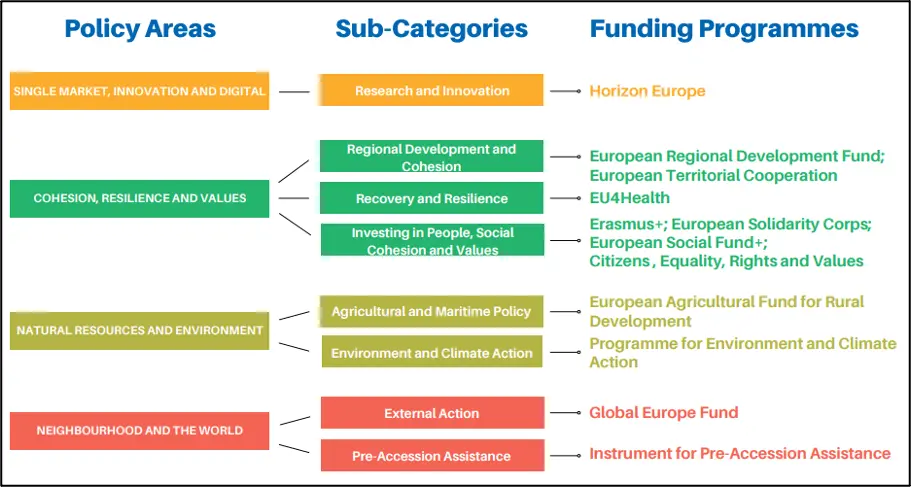
Funding programmes of the MFF 2021-2027

These priorities manifest themselves through a number of different policy areas, targets, actions, and impacts (including on the sport sector), and are supported through specific funding programmes. Accordingly, the available funding programmes address relevant policy fields through the establishment of more than 40 different programmes supporting Member States and ad-hoc third countries associated with the specific programmes to develop and implement EU and national policies.
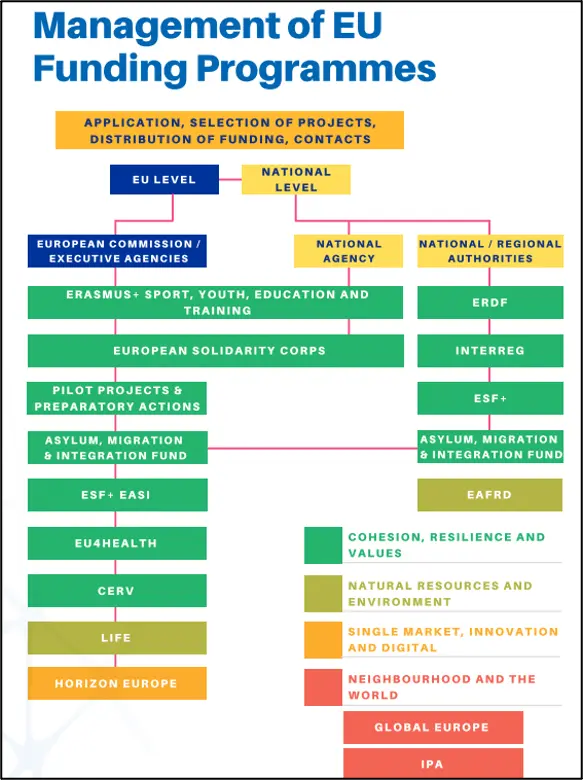
Centralised vs Decentralised Programmes

An important distinction should be made between centralised and decentralised programmes. The centralised programmes are overseen and managed by six EU Executive Agencies and are not under the responsibility of Member States.

In contrast, centralised programmes are instead partially or fully implemented with the support of entities at the national or regional level which is responsible for the management of the whole cycle of the respective funding programmes and their implementation, ultimately. Yet, some programmes are both centralised and decentralised. For example, the Erasmus+ is managed by the European Education and Culture Executive Agency (EACEA) but also by designated National Agencies located in different Member States, depending on the type of activity.
IMPORTANT: The difference between centralised and decentralised programmes is crucial because it determines where to apply, who selects projects, how funds are distributed and who to contact!
Read More

EU Funding Programmes most relevant for sport-sector

There are a number of programmes which appear more suitable to finance a range of sport-related activities among which:

Centralised

Key Action 2:
• Partnerships for cooperation
• Not-for-profit European sport events
• Capacity building in the field of sport

Decentralised

Key Action1:
Mobility projects in the field of sport

Managed by: National Agencies

Pilot Projects and Preparatory Actions (PPPAs)

Centralised

The specific call of the PPPAs in sports change yearly according to the EU priorities, yet some continuity can be seen across years.

European Solidarity Corps

Centralised

Solidarity Activities:
• Volunteering teams in high priority areas
Humanitarian Aid related
Solidarity Activities:
• Humanitarian aid volunteering projects

Decentralised

Solidarity Activities:
• Volunteering projects (team/individual)
• Solidarity projects

Managed by: National Agencies

European Regional Development Fund (ERDF)

Decentralised

The ERDF Regulation sets out its main objectives and funding targets. Yet, each managing authority can implement its
own Operational Programme with specific funding opportunities and priorities based on the needs and demands of each region.

European Social Fund+

Centralised

Employment and Social Innovation

Decentralised

European Social Fund+

European Agricultural Fund for Rural Development

Decentralised

The Common Agricultural Policy Funds sets out the main objectives. Yet, each managing authority implement national and regional development programmes based on the needs and demands of each region.

European Territorial Cooperation (INTERREG)

Decentralised

INTERREG A
• Cross-Border Cooperation
INTERREG B
• Transnational Cooperation
INTERREG C
• Interregional Cooperation
INTERREG D
• Outermost Regions’ Cooperation

Centralised

• Europe’s beating cancer plan
• Disease prevention
• Crisis preparedness
• Health systems/Healthcare workforce
• Digital

Environment and Climate Action (LIFE)

Centralised

Environment
• Nature & Biodiversity
• Circular economy & quality of life
Climate Action
• Climate change mitigation & adaptation
• Clean energy transition

Citizens, Equality, Rights and Values

Centralised

• Union values
• Daphne
• Equality, rights and gender equality
• Citizen engagement and participation

Horizon Europe

Centralised

PILLAR II Global challenges & European industrial competitiveness
• Health
• Culture, Creativity & Inclusive Society
• Climate, Energy & Mobility

Managed by: Responsible Executive Agency depends on the specific policy field.
Read More

EOC EU Office Services on EU Funding

Inform, Advise and Implement

  • Identify, monitor and analyse EU-funding opportunities for sport organisations
  • Inform European NOCs and partners on ongoing developments and opportunities
  • Provide ad-hoc training for European NOCs and partners on EU funding
  • Manage EU sport-related projects and support European NOCs and partners active in EU projects
  • Organise and attend meetings, events, seminars and conferences in-person and online.

Funding Brochure

The EOC EU Office published the third edition of its Funding Brochure namely “Funding for Sport in the European Union 2021-2027” in October 2021. The Funding Brochure provides key information, identifies relevant sources of funding opportunities and contains practical tips on how to approach the different stages of a project cycle: from project idea to the real management and implementation of an EU project. Accordingly, it provides a range of examples of projects that were successfully financed by the European Union in previous years. Hence, the Funding Brochure aimed to be a timely and concrete guide to assist European National Olympic Committees (ENOCs) and sport federations in understanding the available opportunities under the Multiannual Financial Framework 2021-2027.

The EOC EU Office brochure "Funding for Sport in the European Union 2021-2027" is designed to support European NOCs and therefore is exclusively available to European NOCs and EOC EU Office partners. For more information, please contact us at info@euoffice.eurolympic.org

More info about the brochure.

About us

The EOC EU Office is the House of European Sport, representing the European Olympic Committees (EOC), the IOC and other major sport organisations to the European institutions in Brussels.
CONTACT
crossmenuarrow-down-circle linkedin facebook pinterest youtube rss twitter instagram facebook-blank rss-blank linkedin-blank pinterest youtube twitter instagram