The DOSB, SAFE HARBOUR project’s partner, provides a practical and scalable initiative to safe reporting mechanisms, offering member organisations with limited safeguarding capacity the tools and support needed to report and manage cases effectively.
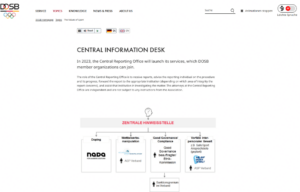
Since January 1, 2023, the so-called “Zentrale Hinweisstelle” (Central Reporting Centre) has been in operation, a service offered by the DOSB to its member organisations. The Reporting Centre establishes a central unit within organised sports that can and should be used in particular by those sport federations that do not yet have their own reporting channel. It offers the advantages of an ombudsman’s office and is intended to make it easier for individuals to file a report. The focus is always on the person making the report, for whom the process of submitting reports and tips should be made as simple as possible. A central contact point helps achieve this.
The Central Reporting Centre serves as a point of contact for all employees, members, athletes and other stakeholders of the associations that have joined the system, as well as external third parties. These individuals may contact the Central Reporting Centre with reports regarding potential legal, compliance, or integrity violations by employees of the association. The office addresses violations of applicable law or internal association regulations.
In the case of specific reports, the matter is forwarded to the Good Governance Officer or the Ethics Committee of the relevant federation.
The service is supplemented by a so-called ad hoc ethics commission. This commission was also primarily created for federations that do not yet have their own commission or good governance officer.
In addition, the ad hoc ethics commission should be consulted in cases of concern regarding bias or conflicts of interest, or if there is no corresponding body within the association. In such cases, the ad hoc Ethics Commission leads the investigation and forwards its report to the relevant body of the federation.
Background information on the SAFE HARBOUR project.
SAFE HARBOUR, standing for “Strengthening Response Mechanisms for Safeguarding in European Sport”, is a 30-month project co-funded by the European Union through the Erasmus+ Sport Programme 2024. Coordinated by the EOC EU Office, the consortium brings together Thomas More and the Asser Institute as experts in safeguarding, human rights and law, alongside 2 International Federations (the International Biathlon Union and the International Ice Hockey Federation) and 20 National Olympic Committees (Belgium, Bosnia and Herzegovina, Croatia, Cyprus, Czechia, Denmark, Germany, Hungary, Kosovo, Latvia, Lithuania, Luxembourg, Malta, Montenegro, Norway, Poland, Portugal, Romania, Slovakia and Slovenia). The International Olympic Committee (IOC) is also involved as an external resource.
The project aims to strengthen the capacity of European NOCs and Federations to address safeguarding concerns by identifying gaps, developing a European Response framework and fostering collaboration. This framework will be adapted to national contexts and complemented by training and awareness initiatives to enhance safeguarding at both national and European levels. Ultimately, SAFE HARBOUR seeks to equip partner organisations with the tools and confidence to implement effective safeguarding measures, establish a robust support network for Safeguarding Officers, and lay the groundwork for a future IOC Regional Safeguarding Hub.