The SAFE HARBOUR Consortium is delighted to share that an academic article based on the SAFE HARBOUR GAP Report was published in the British Journal of Sports Medicine on the 12th of June 2026. The article titled “Ready to respond? Safeguarding structures in European National Olympic Committees” was authored by Cleo Schyvinck, Karolien Adriaens and Tine Vertommen of Thomas More University, one of the expert organisations of the SAFE HARBOUR Project.
Safeguarding readiness across European National Olympic Committees: findings from the GAP Report
The paper starts from the premise that the presence of safeguarding systems can serve as a practical indicator of an organisation’s readiness to protect athletes and respond to concerns. Using this lens, the authors examined the existing safeguarding frameworks in place across NOCs in order to assess their organisational readiness. For the purposes of the study, a safeguarding framework was understood to include designated safeguarding personnel, safeguarding policies, reporting mechanisms, referral pathways and case management procedures. The research draws on survey data completed by the 20 partner NOCs involved in the SAFE HARBOUR Project, part of the wider GAP Report which also captured input from 2 partner International Federations.
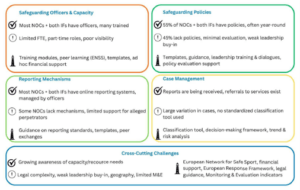
The study identified promising existing structures with regard to the presence of safeguarding officers, safeguarding policies, reporting mechanisms and the management of cases, although the authors note that there is still room for improvement. Indeed, safeguarding officers often combine this role with other duties, reporting mechanisms differ in scope across NOCs, and the use of classification systems for case management remains limited. These findings appear to reflect broader challenges, including limited capacity and resources, as reported by half of the surveyed NOCs, as well as concerns regarding mandates and the coordination of safeguarding efforts with other relevant stakeholders.
Strengthening safeguarding systems through evidence, cooperation and capacity building
These findings shed light on the relevance of the SAFE HARBOUR Project in strengthening the European sports community’s ability to provide safe environments, ensure fair responses to safeguarding concerns, and promote the positive values that enhance the integrity of sport across Europe. Through its new phase on national strategies, the project can help address the lack of policies and training for leadership needed to foster organisational readiness. Its stakeholder mapping work also plays a key role, helping to create links between the relevant stakeholders involved in safeguarding across European sport.
The publication of this article offers a valuable opportunity to share the findings of the GAP Report with the scientific, policy and practice communities, further disseminating the outcomes and achievements of the SAFE HARBOUR Project. The abstract and full article are available here.
Background information on the SAFE HARBOUR project.
SAFE HARBOUR, standing for “Strengthening Response Mechanisms for Safeguarding in European Sport”, is a 30-month project co-funded by the European Union through the Erasmus+ Sport Programme 2024. Coordinated by the EOC EU Office, the consortium brings together Thomas More and the Asser Institute as experts in safeguarding, human rights and law, alongside 2 International Federations (the International Biathlon Union and the International Ice Hockey Federation) and 20 National Olympic Committees (Belgium, Bosnia and Herzegovina, Croatia, Cyprus, Czechia, Denmark, Germany, Hungary, Kosovo, Latvia, Lithuania, Luxembourg, Malta, Montenegro, Norway, Poland, Portugal, Romania, Slovakia and Slovenia). The International Olympic Committee (IOC) is also involved as an external resource.
The project aims to strengthen the capacity of European NOCs and Federations to address safeguarding concerns by identifying gaps, developing a European Response framework and fostering collaboration. This framework will be adapted to national contexts and complemented by training and awareness initiatives to enhance safeguarding at both national and European levels. Ultimately, SAFE HARBOUR seeks to equip partner organisations with the tools and confidence to implement effective safeguarding measures, establish a robust support network for Safeguarding Officers, and lay the groundwork for a future IOC Regional Safeguarding Hub.